
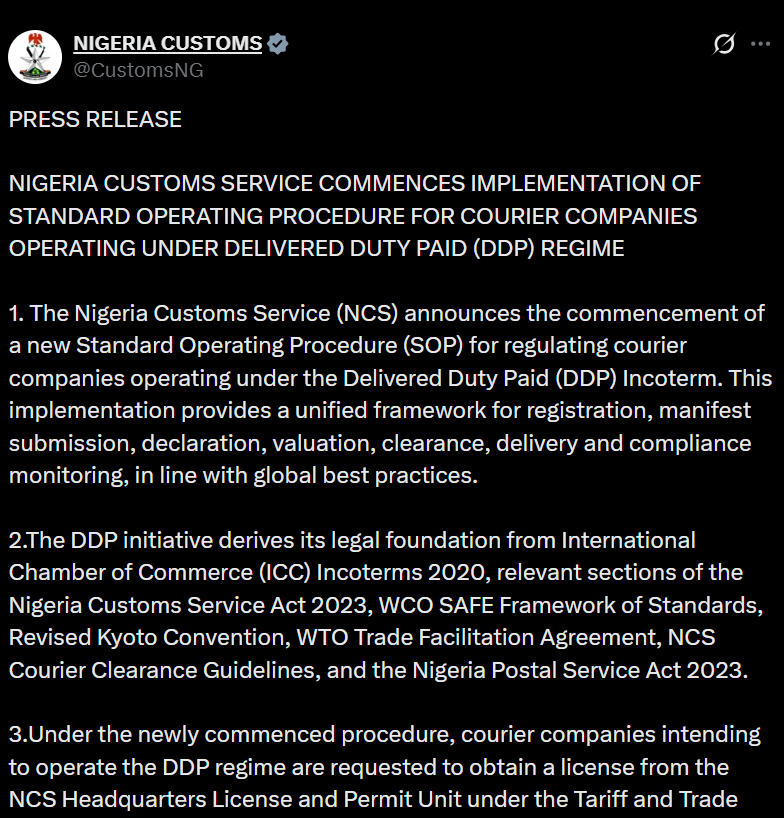
he Nigeria Customs Service (NCS) has commenced the implementation of a new Standard Operating Procedure (SOP) for courier companies operating under the Delivered Duty Paid (DDP) Incoterm. According to an official statement, the new framework regulates registration, manifest submission, declaration, valuation, clearance, delivery and compliance monitoring, and is designed to align with international standards. The Nigeria Customs Service (NCS) announces the commencement of a new Standard Operating Procedure (SOP) for regulating courier companies operating under the Delivered Duty Paid (DDP) Incoterm. This implementation provides a unified framework for registration, manifest submission, declaration, valuation, clearance, delivery and compliance monitoring, in line with global best practices, the statement read. The NCS said the DDP initiative derives its legal foundation from multiple international and domestic instruments, including the International Chamber of Commerce (ICC) Incoterms 2020, the Nigeria Customs Service Act 2023, the WCO SAFE Framework of Standards, the Revised Kyoto Convention, the WTO Trade Facilitation Agreement, the NCS Courier Clearance Guidelines and the Nigeria Postal Service Act 2023. Under the newly commenced procedure, courier companies intending to operate the DDP regime are requested to obtain a license from the NCS Headquarters License and Permit Unit under the Tariff and Trade Department. They are expected to submit all mandatory documents, including CAC registration papers, valid courier licenses, compliance bonds and a formal application to operate under DDP, the statement added. The SOP also requires operators to submit an Advance Electronic Manifest (AEM) at least 24 hours before shipment arrival, clearly indicating DDP as the Incoterm and including full details such as HS codes, item descriptions, values, origins and consignees, in accordance with the WCO SAFE standards. The NCS said the framework mandates courier companies to act as declarants by filing Single Goods Declarations (SGDs) via the BOdogw platform. Declarations must include declared FOB values supported by invoices, airway bills and packing lists, while full payment of customs duties, VAT and other statutory levies must be completed before clearance. The statement noted that cargo profiling under the new procedure will be risk-based, with physical inspections triggered only when discrepancies or high-risk indicators are identified. Delivery to consignees will be permitted only after clearance is completed, and Proof of Delivery (POD) must be provided upon request. To enforce compliance, the NCS has instituted periodic Post-Clearance Audits (PCA) to verify declaration accuracy, prevent revenue leakages and ensure adherence to classification and valuation standards. Offences such as false declarations, non-payment of duties or operational breaches will attract sanctions including licence suspension or revocation, seizure of goods, penalties with interest and prosecution under the NCS Act, 2023. Courier operators are also required to submit monthly reports of all DDP shipments, including duty payments, classification details and delivery records. With this commencement, the NCS reaffirms its commitment to strengthening the integrity of the clearance process, enhancing revenue assurance, facilitating legitimate trade and ensuring that courier operations under the DDP regime meet the highest global compliance standards, the statement concluded. The release was signed by Deputy Comptroller of Customs, Abdullahi Maiwada, National Public Relations Officer, for the Comptroller-General of Customs, dated January 12, 2026.
The post Customs releases new operating standards for courier companies appeared first on Linda Ikeji Blog.

 South Africa to expel Kenyans working on US Afrikaner ârefugeeâ applications
 Man âstoned to de@th on Kent beach after trying to meet 16-year-old girlâ
 Former beauty queen and actress, Regina Askia shares new photos as she turns 58
 Singer Lizzo speaks out after fat-shaming claims is dropped in legal fight with former dancers