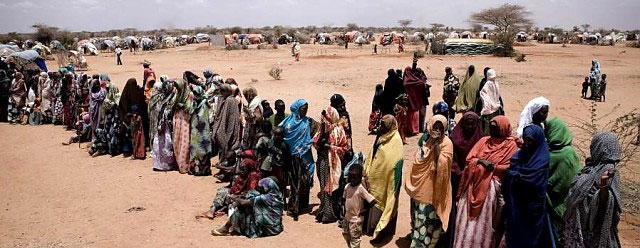
The World Bank has set aside up to $12 million in performance-linked financing for Nigerian states hosting internally displaced persons (IDPs), under a new federal project aimed at closing long-standing data gaps on displacement and improving the integration of IDPs into development systems. The funds form part of a $300 million concessional credit approved on August 7, 2025, under the Solutions for the Internally Displaced and Host Communities Project, and will be disbursed only after independently verified results are achieved.According to project documents, disbursement under Performance-Based Condition Two will reward states that successfully register and profile IDPs living in host communities. Payments will be spread over three years and escalate as requirements deepen. The arrangement places strict data, governance and verification conditions on participating states, marking a shift from traditional development lending to measurable outcomes.In the first year, participating Tier 1 and Tier 2 states must launch registration and profiling of IDPs in selected host communities and complete demographic and vulnerability assessments in at least two wards. States meeting the threshold will receive $250,000 each. By the second year, Tier 1 states must conduct intention surveys, stability index assessments and produce detailed analyses of the drivers of displacement, socioeconomic impacts, outward migration pressures and risks linked to trafficking and smuggling to unlock an additional $500,000.The final and largest payout comes in year three, when 80 percent of IDPs in host communities across all participating states must be registered and profiled. States meeting the target will receive $500,000, bringing the total allocation under the condition to $12 million. By year four, the agreement expects displacement-related data gaps to be comprehensively addressed, with no further payment attached to that phase.Beyond IDP data, the financing agreement includes two additional performance-based conditions. Performance-Based Condition One requires participating local governments to strengthen asset management. Tier 1 states must issue asset inventory guidelines and operations and maintenance standards aligned with international benchmarks, followed by audits and approvals. Up to $9 million is tied to this condition, with disbursements of $500,000 at each verified stage.Performance-Based Condition Three focuses on long-term integration of IDPs. States must support access to legal documentation such as birth, marriage, education and residence certificates, as well as travel documents and driving licences. Those completing the stage become eligible for $1 million each. Later milestones require legalising transparent land and property transfers to IDPs, establishing monitoring mechanisms to prevent tensions with host communities and opening development programmes in skills, livelihoods or infrastructure to displaced populations. A total of $12 million is allocated under this condition.Only states meeting strict eligibility criteria may take part. Tier 1 states must have more than 150,000 IDPs representing over two percent of their population; Tier 2 states qualify with at least 100,000 IDPs or more than one percent of the population. States must also sign subsidiary agreements with the federal government and adopt approved security management plans. All performance claims must be verified by independent agents acceptable to the World Bank, and the Bank may withhold or reallocate funds if milestones are not met.The broader $300 million package will finance infrastructure, livelihoods, institutional strengthening and project management across northern Nigeria. Repayment of the credit will begin January 15, 2031, and run semi-annually until July 15, 2050. The World Bank Group remains Nigerias largest external creditor at $19.39 billion, equivalent to 41.3 percent of total external debt, underscoring its central role in the countrys development financing.The post World Bank approves $12m loan for Nigerian states hosting IDP camps appeared first on Linda Ikeji Blog.

 CBN forecasts petrol price at N950 per litre in 2026
 Teenage girl and a lady arrested for attempt to smuggle hard drugs to Kano prison inmate
 Ndigbo are no longer spectators in the Nigerian project- Minister Dave Umahi dismisses calls for Biafra under Tinubu’s administration
 Branding Lekki tollgate incident as m@ssacre is fake news – Lai Mohammed