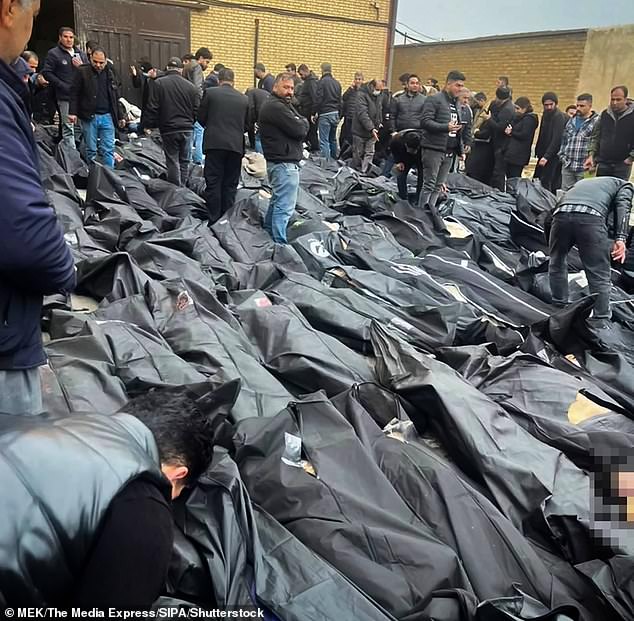
The Islamic regime has been executing injured protesters in hospital beds by sho0ting them in the head, according to an Iranian doctor. Dr R, a member of the Aida Health Alliance, said that many wounded civilians had been found lying in their treatment beds, still attached to machines, with bullet holes in their heads. They accused the Islamic Revolutionary Guard Corps (IRGC) of murdring those injured following the Tehran protests and also arresting several medical staff suspected of treating them. ‘If the patient already had the sh0t in the head [when they arrived at the hospital], nobody would put the tube or catheter in because they’re already de@d,’ the doctor told The Jerusalem Post. ‘So it means they went into the hospital and they k!lled them on the treatment bed.’ Dr R also shared chilling images with the newspaper of bodies in black bags with bullet wounds to the head, surrounded by blood, and still connected to medical tubes and catheters. These photographs have not been independently verified. Iran Human Rights director, Mahmood Amiry-Moghaddam, said: ‘The testimonies of doctors show that the Islamic Republic has trampled even the most basic human and medical principles and has systematically used hospitals as instruments of repression and killing. ‘The deliberate shutdown of ventilators, the prevention of treatment for the injured, and the arrest of patients from hospital beds constitute crimes against humanity and demonstrate the complete collapse of any ethical or legal standards in this government.’ He added: ‘When states use hospitals as tools of repression, this is not merely a human rights crisis but a global public-health crisis. ‘We call on the World Health Organisation to examine reports concerning the conversion of hospitals into instruments of repression, the denial of medical care to patients, and the obstruction of medical staff from carrying out their professional duties. ‘Such investigation is essential to protect lives now and to ensure accountability and justice in the future.’ Dr R also claimed that civilians uninvolved with the protests have also lost their lives as collateral damage due to the Islamic regime’s violations of medical facilities. On January 8, when the regime cut off internet access and severely restricted landlines as part of a communications blackout, people facing medical emergencies were unable to call for help, they said. ‘Some people, the old people having heart attacks and the women going into labour, they couldn’t call the ambulance to come and just help them,’ Dr R added. ‘Some people [were] dead like just that because of not having access to call paramedics.’ Medical professionals have also not been spared, the doctor explained. They claimed that many doctors have been arrested, tortured, and even sentenced to de@th because they had been treating those wounded. ‘They’re still tracing the doctors. They’re still trying to convict them for helping the enemy’s country, or [accusing them of] espionage,’ Dr R continued, later adding that medical students have not been spared from the regime’s brutality. Following shifts at the hospital, where medical staff are expected to report any suspected protest-linked injuries, Dr R said they are followed home by IRGC forces to see whether they make any home calls to demonstrators. Recounting one incident, the medic said a teenager who had been shot in the genitals during the protest was left to be treated at home after his widowed father deemed it too unsafe to take him to the hospital. He later died of his wounds. ‘You cannot believe how many patients we receive every single day that are at home. They didn’t go to any doctors. They didn’t even have a chance to go and get the X-ray to just address those bullets… Sometimes we just see that the bullet is [still] inside, [and] is infected,’ Dr R said. It comes as Iran’s president apologised to ‘all those affected’ by the nationwide protest and bloodthirsty crackdown that followed it.The post Iran ‘is executing protesters in hospital beds with patients sh0t in the head while still wired up to machines’ appeared first on Linda Ikeji Blog.

 Driver and female passenger burnt beyond recognition as fire razes commercial bus in Lagos
 FG debunks open grazing ban, says transition to ranching gradual
 Nigerian man sentenced to one year imprisonment in India for possession of cocaine
 Jealous aunt drowns niece, 6, at wedding because child âlooked prettier than her,â admits to murd3ring 3 other relatives